

Zombie
Glimpse from the 2026 road, 3

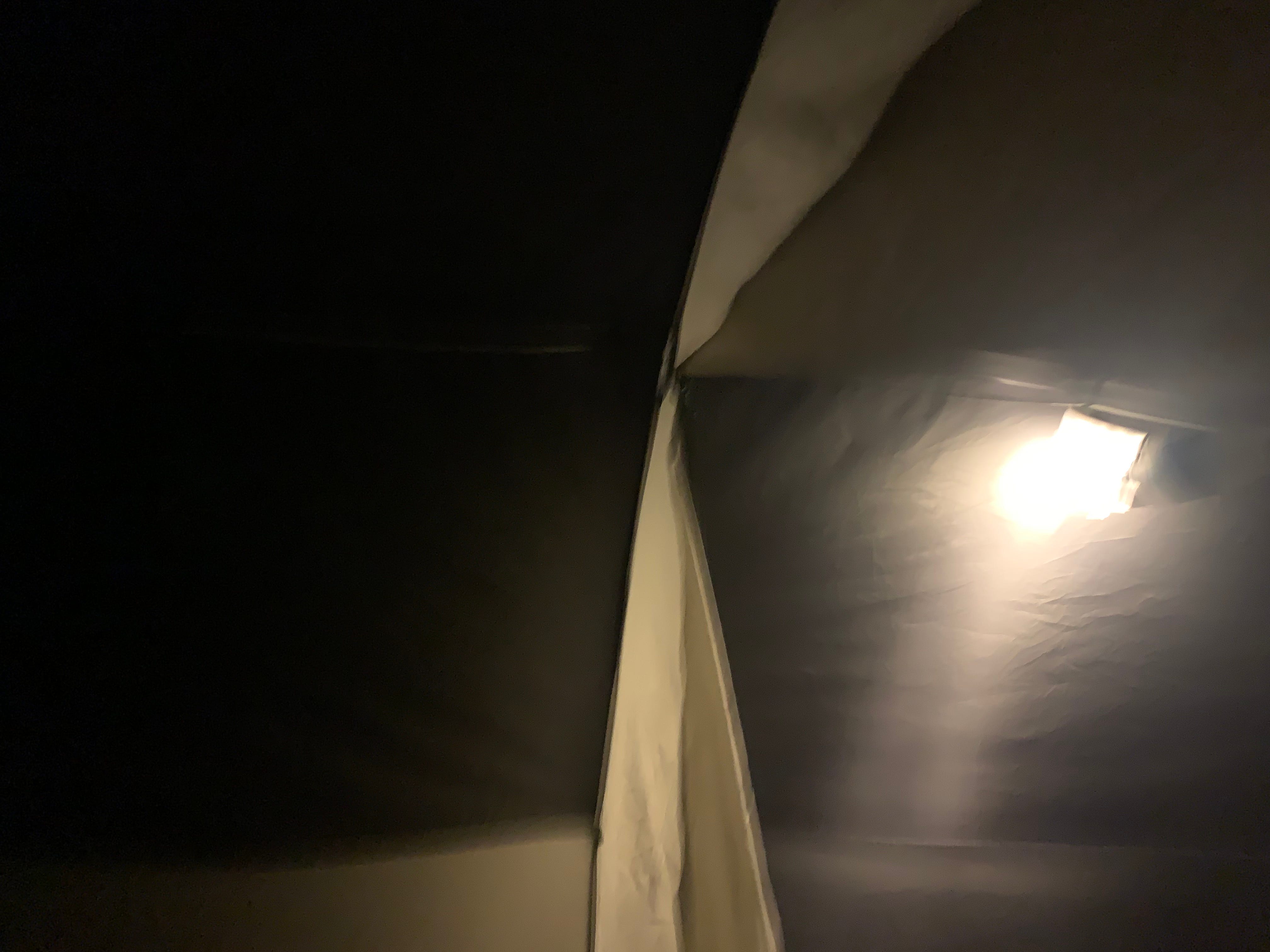
This isn’t a story about you.
You aren’t going to tell this story. You’re not sure you like what it says about you. You’re not sure what it says about you. You don’t know why, exactly, you think it says something about you. Or maybe you just don’t want to be the cause of worry.
Your eyes open and take in the hazy yellow square of light above you. You toss your fluffy blanket to the side, and the cool outdoor air drifting in from the roof fan rinses heat from your cheeks and chest. You’re groggy. But it could be worse. May your sleeping superpower never fail you. Or maybe anyone could have slept past 10 am—despite sunlight streaming through fan, despite steady hum of combustion and mechanical motion starting and stopping, starting and stopping, despite din of one-sided phone conversations and short-lived barks and tired feet on pavement, despite faint smell of cigarettes and hot rubber and exhaust—after the adrenaline letdown finally came. What time was it when you pulled in here? 4 am? And where, exactly, is here again?
Taking a sip, you set the plastic Coke bottle in the not-deep-enough drink holder. Three in the morning felt too odd a time for coffee. And you needed something just in case. Not that it seemed likely you’d feel anything but amped anytime soon. It was a good call. That and the Snickers bar for comfort. You’re going to need to stay awake for just a bit longer. The rest stop you just passed was closed. And you’re sure as hell not searching around this unlit—is it even a town?—for a spot.
You set the candy and soda on the counter heavily and fish—in your bag for cash, by making your body the shape of a sigh for a gentle how goes, for the container of a fellow human’s gasp in which to place a small piece of your shock. When the pause lasts a space too long, you look up. The girl points to a sign: “Lost my voice,” it reads. “Hearing’s fine. Please don’t yell.” You nod. “I’m sorry,” you say and then in a lower volume, “What a bummer.” She shrugs. Mouth-rasps, “$4.50.”
For the third time (and at the fourth gas station) in the velvet dark of early hours—those hours when it seems the world’s slipped into an invisibility cloak, and you can almost make out its contours if you peer just so—you hop down from the lofty cab of your newish-to-you van; flip open the door to the gas tank; and fight the often-stuck, always annoyingly greasy and cloyingly sweet-smelling cap open; and insert the diesel nozzle. Only this time, a light’s on in the station. And you can see movement through the glass doors, an employee walking the aisles, a customer filling a styrofoam cup. And the light overhead is bright. And you can fill your tank. When a sedan pulls up, and three young women the age of your daughter pile out, giggling, you feel your muscles get a tiny bit less taut. You follow the cocoon of their laughter inside.
You typically love an open road, you remind yourself. You’re trying to think of anything but putting distance between you and the last town, between you and all that’s transpired in the last hour or so. Anything but the fact your tank is mere miles away from empty. Pushing pedal to floor, you curse the governor. (You’ll save the story of its discovery for another time, suffice it to say you were cursing it then too, only not yet sure what you were cursing.) This van, before it was a home, before it had a shower and an oven and splashes of bright colored wall coverings that look like stained glass and the succulent you took from an Arizona desert six years ago whose resilience is a magic trick bumping gently in its windowsill, was a delivery van. What kind of a sadistic company wants to prevent its employees from exceeding 74 miles per hour? You shudder to think of an eighteen-wheeler at your rear barreling down a hill, a line of vehicles flying by in the left lane, barely a space between them.
“Absolutely not,” you say out loud. And then, arguing with the silent response in your head, “Well, I’m not on empty yet, am I?” You pull onto the on-ramp adjacent to the off-ramp you just took, heading south once more and leaving the nearly lightless station with the lone pick-up truck parked near the pumps, a shadowy figure behind its dark windows.
You’re unaware of the waning crescent moon high over the horizon as you whip onto the freeway a little before 3 am. All you notice is how desolate it is—like you in the tall cab of your tall, boxy van are flying through a realm heretofore un-accessed, where sound and time are swallowed and maybe you are too.
“You have to be kidding me,” you mutter through clenched teeth. At least your intuition wasn’t off. Slamming the driver door shut, you wonder how you knew. How, you managed, only a couple gallons into filling your very empty gas tank, to pull the nozzle out, drop it into its cradle, pop in the cap, and climb into the cab—just as the guy with the vacuous gaze wandered into your line of sight. His wiry beard and thick belly and the pack on his back are a stony gray in the low, bluish light of this otherwise empty Valero station with its overpriced diesel. He’s moving at an angle toward you but not looking at you. How did he cross that massive intersection so quickly? you think as you pull out onto the road, give thanks to the light at the intersection before the southbound on-ramp for being the color of go, and pull onto the ramp.
“Sorry. Were out of deisle.” Of course the diesel’s dry. Of course, there’s a misspelled sign scrawled perpendicular across a torn, lined notebook page hanging like a lopsided scarecrow without a field in the stillness of this ghost gas station. Of course, it’s back to where you started.
You can’t quite wrap your mind around how such a terribly short trek took such a terribly long time. And you feel a little like a kid picking yourself up from a tantrum over a gumball knowing you did it just to save a couple of bucks. But it’s done. At least you can finally fill up the tank and put this trap house of a city in your convex spotter mirrors. You shake your head, thinking of P’s warning. What was it he’d said about this corridor of the I-5? Careful. It’s methy out there. Something like that. You see the man just before you open the door. He seems to have just appeared. His movement must have caught your eye. He isn’t really looking your way. But he isn’t really not. Standing partway in shadow, partway in the dim, corn yellow light of the doorway to the closed gas station, he seems to be staring into a dimension beyond the one only he and you share, the pissed-off guy in the car having roared off into normal long ago. You tell yourself to be real. He’s probably just a dude down on his luck trying to keep warm; this isn’t typically the kind of thing that would throw you. But you can hardly blame yourself. When the man shifts and moves forward, his steps spaced-out and jerky, the decision’s easy: Cross the street to the other station with the same lower price.
You will not later remember if you just went through the red light or continued to wait.
See, you tell yourself, upon seeing the Valero minutes from the freeway entrance. You come to a stop at the red light alongside it. Turning around wasn’t a bad choice. “I didn’t really think it was,” you mutter, because you need something to push back against, something to defeat. You’re about to turn right so you can swing into the Valero entrance when you notice the lower diesel prices at the two other gas stations, one on either side of the road across the multi-lane thoroughfare. You refuse to be cowed into buying more expensive fuel. When a car pulls up behind you, you’re relieved. You can almost feel the warm rays of empathy this fellow driver would feel if he knew what you’d been through. How much time has gone by when you start to feel trapped—or, worse, like the trapper? You feel yourself bounce on your seat. You glare at the traffic light as if you could turn it green with your gaze. You tell yourself your sense of timing is off. You scold yourself for not having stopped in the left lane. You inch forward, lest there’s some trigger beneath the road the tires need to hit. And is this light broken? You have a thought your half-asleep mind and half-adrenaline-fueled nervous system can’t transfer into action. And then your road buddy is honking and pulling around you and, though, you’re cab is so far above his you can’t see inside, you can feel the energy of his middle finger raised in your direction. Fair.
You’re being the character who runs up the stairs to escape right now, you tell yourself. Hush, you respond. No, it’s not a perfectly executed escape. But you’re not dealing with any superhuman strength. Or weapons. As far as you know. And sure, you’re driving back past the “scene of the crime.” But it’s clear on the other side of the strip mall—across three empty traffic lanes and a median and another three empty lanes. And you’re driving. And part of you wants to laugh at your bungling. But your hypothalamus is still firing signals to release hormones you’re pretty sure you no longer need.
You’ve made it only a block or two before you realize you’re driving north. Moreover, you’re making your way deeper into the city. Just turn around, you tell yourself, flipping the bird at the useless phone in its magnetic mount.
Back in the cab, you gulp water. OK. Get on the road. Or rather, (ridiculously) get to a gas station. Whatever. Just go. You’ve been sitting here for too long. You push the male end of the magnetized car charger into the cigarette lighter, snap the phone in place, and pull up Google maps. If there’s any time to just use a maps app and not think, this is it. The app remains entirely gray and white, a spinning loading wheel where there should be street details. You tell yourself to be calm. Close the app. Start over. There you are a blue dot in a sea of white. No map details. You glance back in the direction you came from. You still don’t see any movement. In fact, there’s no sign of life in any direction you look. But there’s a whole lot of shadow between this section of strip mall and the one you tore out of on the other side of a thin road. “Work,” you hiss. The loading wheel spins. You don’t need a map, you tell yourself. You can’t sit here any longer. It’s true. The street in front of you is a main thoroughfare. It will connect to the highway. You tell yourself to think about the route you took to drive here early yesterday evening. But you did a whole lot of circling, looking for decent bandwidth. And you’re groggy now. Go!
Nothing appears in either side mirror or on the backup camera (which currently isn’t simply a blue screen, but that could change at any second). “Stop,” you say to your trembling hand. You open the steel door between cab and house, glance back to make sure all is secured, and relatch the door firmly so it won’t bang open when you turn a corner. This is when you notice the thank is nearly empty. Fresh air! It’s a demand. Throwing the driver door open, you slide onto asphalt and breathe. This lot, empty but for a newspaper section splayed half-open where it fell and two or three clearly unoccupied vehicles, is better lit than the one you just fled. You walk to the van’s passenger side and then around the rear. You find no damage. Enough. Nothing stirs in the shadows behind you. You need to move.
You just keep going. Straight. Across both lanes. Into the adjacent strip mall lot. You can afford to stop and assess for two seconds.
You’re fairly certain he’s not giving chase. And you know you can outrun him. And your hands on the wheel are quivering. And you can feel the river in your blood pulsing, hear its close roar. And which way should you turn?
You realize too late that the far exit would have been the better choice. Crossing the lot, you could have quickly gotten up speed. But you’ve already turned toward the closer exit. Now you have no choice but to decelerate to navigate the parked trucks and then slow even more to make the sharp left into the narrow exit. Whatever you do, you can’t need to back up to pull off this turn. You don’t know where he is. You imagine reversing, a soft thud, and feel sick.
You shoot straight forward. Do you hear a gasp of surprise? Another moan? See wide eyes in the sideview mirror?
The body’s reaction to fear is so incredible you almost want to pause and watch it at work: The surge of resources to your extremities so they vibrate with power and strength. The coldness of clarity in your cheeks and belly. The master clock deep in your brain slowing everything to a crawl. Every cell a whispered roar: Run. Your quaking hand pushes the key into the ignition and brings the engine to life. Now, the tall ball-capped figure is yanking at the passenger. You wish he would let go. You don’t want to hurt him. Even now, that part of your mind that’s functioning in the background is deciding that, even when you’re safe and away, you won’t dial 9-1-1. To what end?
You have to do this. At last, the pounding on the driver window stops. The man (later you’ll realize any description you might have made would have been poor—male, ball cap, you think, vest, maybe, a foot taller than you based on where his head hit the window) the man finally lets go of the door handle. As he makes his way around the front of the van, he hugs it with his like it’s a life raft, like it’s holding him up, his hands thumping the hood as he goes. Now. You jump into the driver’s seat.
You can’t bring yourself to step into the cab, to put your head inches from the head of this desperate figure. Meeting his eyes feels unthinkable. The part of you that takes care of you already knows he won’t get in, knows you’ll drive away. Still, you’re frozen. And why isn’t someone from the truck camper to your right responding? You can do this.
Shit. You weren’t fast enough. Three actions coincide: You slide open the door to the cab with one hand. The moaning, shivering presence incarnates at the driver’s window, head pressed against the glass. You tap the house light off with your other hand. You imagine you must have appeared to him for a millisecond standing in the doorframe in a halo of light. The figure pounds on the glass and yanks on the door simultaneously, alternating hands and occasionally knocking the window with the crown of his head.
Pee jar. Computer. Shoes. In the darkness, you feel your way out of bed; wedge the jar next to the toilet; tuck your laptop, mouse, and keyboard behind the couch cushions; and tap on the light to grab your shoes, annoyed you didn’t store the laptop before going to bed in a place like this.
Oh. It’s time to go. Now. He’s trying to get in. You hear the snap of the handle directly below as whoever outside jerks it, attempting to open the door against which your pillow is leaning.
When the van shudders slightly, you think about how even a heavy breeze can cause a sway up here in your “loft bed.” Then a long-ago jostle—back when your bike got stolen from the rear rack of your other van as you lay sleeping—pops into your mind. Next comes a jolt, followed a snapping sound it takes you a second to register beneath the shuddering lamentation.
Hold still, you tell yourself. Poor guy will move on in a second. You think of how cold it’s been these past few days. You remember covering the opioid crisis back in West Virginia. You never wrote a headline like the ones you read elsewhere across the nation: “Small Town Devastated.” Instead, you pissed off law enforcement by painting and photographing what you saw: Men in uniform salivating over their boon of tactical gear—surplus military equipment meant for Iraq and Afghanistan the Department of Defense instead transferred to enforcement agencies across the country. Men donning camo and night-vision goggles and low-crawling down hills to bust couples with stringy hair and sad eyes and empty bank accounts, kids with damaged teeth and hollow hope. The only female sheriff’s deputy carrying a toddler in her arms passed men wielding a battering ram toward a hazmat tent. The circuit court judge (who’d more than once defended your right to be in the court room) handing down a time-served sentence plus rehab to the girl with rippling blond locks who, you learned from a public defender, asked to take her curling iron to jail, while doubling or tripling the sentence for her codefendants cooking meth from codeine in her apartment. Didn’t they all need help, not bars? It was devastating for some, for sure. You miss that work. And how isn’t it any better two decades later? And why isn’t the moaning getting dimmer?
You should have known better than to park in the lot of this chain gym in this town. It won’t be until you’re miles south that it hits you: Another sound came before the wailing—the slamming of a door. The truck camper parked next to you will flash into your mind. You’ll recall it was parked there when you made dinner and washed dishes in the soft light of evening before pulling your shades. For now, you’ll just think, Now what?
What time is it? Your befuddled mind is filtering through images to get to where. The phone next to the bed tells you when—2:30 am. You gasp. What woke you registers. It’s loud. Somewhere between a cartoon-exaggerated teeth chattering and a continuous low moan of desolation. And it’s close. Too close. Your whole body shudders.
Oh my goodness, Holly - I felt for you here.
The part of you that takes care of you, is the voice that should always be listened to. That’s something I have learnt.
Incredible point of view to write from Holly. 🫣 whoa…..
It invited me in to the place in my own mind where I rationalize stuff to myself.
To read, and simultaneously be inside my own head sensing this event, is raw fear.
It’s moments like this that make me wonder if the sound of cocking a rifle… or maybe even starting up a chainsaw would’ve scared away the crazed man outside.
Be safe, dear one.