

Choices
Glimpses from the 2026 road, I

A girl, 5 maybe 6, languishes at the center of a small footbridge at the side of the field. Her body, in an awkward, not quite crouch, lists in one direction and then the other. Her eyes, glossy and unfocused, follow the same path. Dark hair falls below her ears, a few strands matted to damp cheeks. A jacket sits askew on her shoulders, the zipper halfway up one side, a tiny tongue out to the other, which would flap if there were a breeze.
She’s the first person I’ve seen since I rolled into this campground an hour or so back. I shiver and wait, unseen, for her adult to appear.
Soon, a small woman, hair spilling to her waist, a toddler spilling from one hand, appears and rushes both toward the restrooms. “I couldn’t wait.” I catch the words, soft and forlorn, as I turn back to my van.
I should get on the roof and secure the tilted-up corner of the fan cover. You can feel what’s coming gathering itself. In the stillness. In the washed-out brightness—flaky white maple branches disappearing into flaxen white air, dusty ground the color of beach sand—as if, behind the muting layer of clouds, sky has its aperture wide open, its breath held, taking in a world about to be transformed.
The door of the rig next to mine is slightly ajar now, though it’ll be closed by the next time I look. We’re two of three docked in the handful of sites with electricity, water, and sewer hookups, a dirt path and a copse of coiffed conifers and naked deciduous trees between us and the sites where those who call this place home on a more permanent basis are parked.
Nearer is a mostly empty parking lot—later, I’ll notice a couple in fleece next to a jeep with a not open rooftop tent seemingly in flirtatious debate—and the green field. On it sit two tents, one with a car parked in front of it, the other with a small wagon at its side.
After rushing two loads into the machines in the laundry room, I gather water bottles and head to the spring well beyond the far side of the field. The woman, next to the tent and wagon, hovers over a picnic table stacked high with things. By the time I return from the fountain, the table is mostly empty, she’s stretching a tarp atop the rainfly, and the jeep has disappeared.
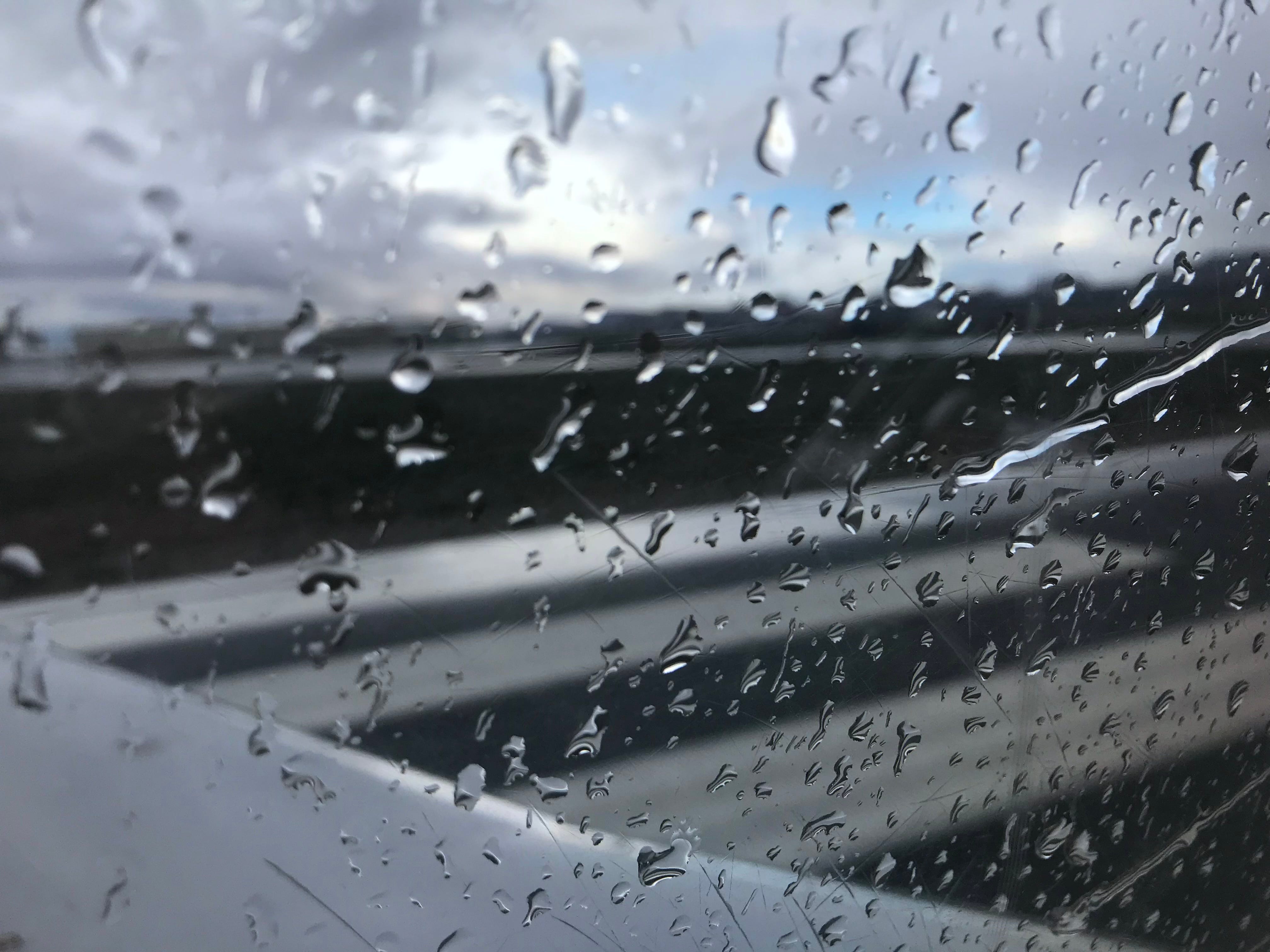
I’m back inside when sky aperture snaps shut, and clouds, bursting in anticipation of the cue, spill themselves into dusk. Rain sluices the windows as I cook dinner. Rain spits at the walls as I curl on the couch with a book, heater blasting. Rain beats on the roof above my bed like I owe it rent.
During an intermission that could be morning or could be afternoon, I slip outside—into blue. It’s like, below the navy sky, you can see the campground’s breath, a powdery cornflower haze that settles around slate-colored earth and its liquid steel pools, around indigo branches stripped bare, and around the two tents in the field.
Just as I step from the stall, the trio trickles into the restroom. “Is it you again?” the woman says. I pull my beanie away, so she can decide if I’m you. I’m not.
We exchange names, and she starts to say, words spilled out and then yanked back like a startled rabbit turned statue in the rock of her throat, she knew mine before I said it.
“I love it when that happens,” I say quickly. And her words return.
We talk about names, the one she was given at birth, the one she gave herself. How long this torrent is meant to last. How the eviction came quickly when they were no longer able to make rent. How nice it would be to have a car.
“Are you staying dry?” I want to know.
“Mostly,” she says, adding, “We have a heater.”
All the while, I can’t stop making eyes at the toddler attached to her leg. Listen, I keep telling myself, meaning to the “no thank you” in the wide-eyed, upward stare the little one returns. Still, I keep dipping into my bag for funny faces and winks and playful smiles.
When the woman turns the conversation to what’s happening to people who look like her and her children, saying, as if trying and not liking the taste, that maybe they’re safer this way, her words become the same wide-eyed stare. “Living inside doesn’t really work for my family anyway,” she concludes with more conviction.
Washing and putting away dishes, I think of the things that couldn’t be packed with the trio into their nylon triangle, now sloshing in a little wagon. Imagining the vistas up ahead, I think of why I’m out here. In a few weeks, when I hear snow has come to the campground, the trio will hunker in my mind.
I take a call from a friend. “Oh,” she says when she learns what town I’m in now, “I have a friend whose mom has a house there. It just sits empty. I think it’s something like one of ten places she has like that.”
For the comments, has circumstance ever forced you to live in a way you might not otherwise have chosen? Do you use the name you were given at birth or you gave yourself? When have you felt stuck between two not so great options?
Your likes and shares and restacks (that little recycle button) mean the world to me and help my writing get discovered. If you’re not sure how to like, comment, or restack, pretty please reach out and let me know.
Thank you for sharing, Kara!!
I can’t believe there are people like you out there recording what is happening as if it is poetry, and it is, but also heartbreaking. Yes. I know the person with 5 houses who moves between them. And then there are so many “writers” I observe doing a sometimes convincing job of pretending they are writing. But you can always tell who is really putting all the pieces together to make it sing.